Donald Trump told protesters in Iran that “help was coming” little over a month ago.
But there was almost no US military presence that would have made a difference in the region.
On 22 January, he said there was a ‘great armada’ assembling, when what he was referring to was the aircraft carrier, the USS Abraham Lincoln and its attendant Carrier Strike Group 3.
None of it matched his rhetoric. But by this weekend, it will have done so, as a powerful US military force assembles within striking distance of Iran. It has three main elements.
First is the naval force. The Lincoln and its CSG 3 will shortly be joined by the USS Gerald Ford, and its attendant CSG 12. The USS Ford is passing through the Gibraltar Strait in the next 24 hours and can be expected to be on station south of Cyprus in about four days, travelling at normal cruising speed.
These two Nimitz-class carriers (CVN 72 and CVN 78) will be bringing extra air defence and Tomahawk-carrying destroyers with them, bringing the number of known, and named, US destroyers in the region to 11. They will join three Littoral Combat Ships already on station and a good number of support ships as well. In addition, each CSG includes – though never usually named – a nuclear attack submarine (an SSN), probably of the Virginia class.
And there may also be an Ohio-class SSN in the area, which is specifically designed to launch Tomahawk and other missiles at land targets.
The second element has been provided over the previous 10 days by an extensive series of C-5 and C-17, Galaxy and Globemaster flights in and out of the region, bringing air defence assets to US bases, presumably as cover in the event of any Iranian retaliation in response to potential US attacks. Israeli ‘Iron Dome’ air defence batteries have also been moved from its frontier with Gaza to its borders in the east, probably for the same reason.
And thirdly, the US has sent an extensive force of KC-130 air-to-air refuelling tankers to bolster its existing air tanker force. They left from the British base at Mildenhall (six tankers on 16 February) to Greece, and (on 18 February) no fewer than 10 more came from bases in the continental United States, via Britain, to bases in Greece and Bulgaria. In addition, US aircraft are known to be in the British base at Akrotiri in Cyprus, at Aviano in Italy, in the Azores, in Spain and at the Chagos Island base of Diego Garcia. Well over 100 US combat aircraft – F-15s, F18s, F-22s, F35s and B2 bombers – are now available to US military planners in the potential theatre of operations.
But the extra KC-130 tankers are the giveaway. They give away the possibility that US aircraft might be operating from bases not sited on the territories of America’s Middle East allies, but from less politically sensitive bases further away. And they give away the possibility that any air campaign might be quite prolonged, not just a sudden one-off attack.
The final piece of the jigsaw: no fewer than six E3 Sentry aircraft. These flying control centres can survey and control everything that happens beneath them. They are, in effect, flying HQ’s and a country can run a war from one of them. By the weekend, there will be a lot for these six E3 Sentry aircraft to look at and control.
What all this military power will be used for is still a matter of some speculation.
What does the tracking data show us?
By Freya Gibson, junior OSINT producer
Sky News Data & Forensics team has tracked the locations of US military planes and ships heading to the region in recent days and weeks.
Several US Navy boats have been sent to the Middle East, including the USS Abraham Lincoln, a nuclear-powered aircraft carrier that carries 90 aircraft , including F35 fighters, and 5,680 crew. The Lincoln is leading a carrier strike group which includes three destroyers. The ship was last seen in the Arabian Sea around 240km off the coast of Oman. Sky News confirmed the location of this ship on 15 January.
In addition, the USS Gerald R Ford, the lead ship of the US Navy’s nuclear-powered aircraft carriers, is en route to the Middle East. Sky News has confirmed its latest location as tracking shows the Ford was around 600km from the Strait of Gibraltar at 1.58pm on 18 January. This aircraft carrier, like the USS Abraham Lincoln, also forms a carrier strike group that includes three destroyers. In total, there are reported to be more than 12 US ships now in the Middle East.
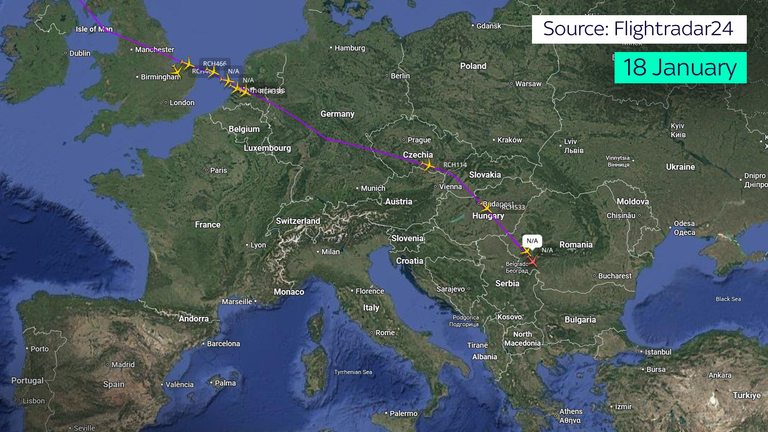
Sky News has also tracked movements of US aircraft
Sky News has also tracked movements of US aircraft in the region. More than 15 refuelling tankers have repositioned towards the Middle East and Europe since 16 January. These aircraft, the K-135s, are aerial refuelling aircraft. They can carry up to 200,000 pounds of fuel and 83,000 pounds of cargo. They have four engines and operate at speeds up to 530mph and altitudes up to 50,000 feet.
The aircraft came from multiple locations, including RAF Mildenhall in the UK, Tampa in Florida and Sioux City in Iowa. They have been landing in different locations, including Chania Airport in Greece and Sofia Airport in Bulgaria.
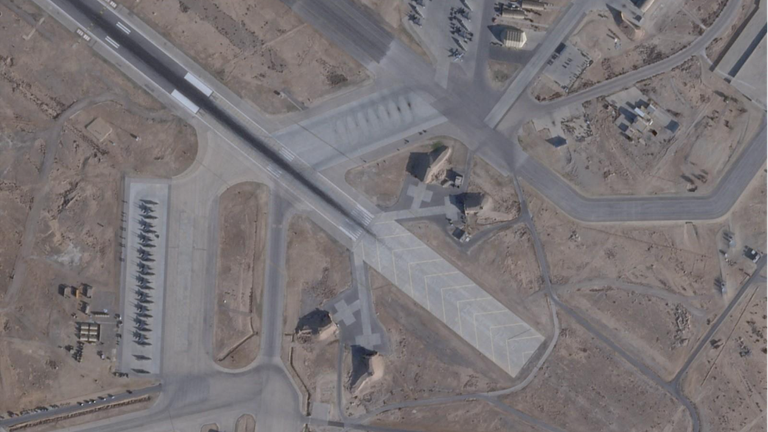
Satellite imagery shows F-15s and A-10 Thunderbolts at Muwaffaq Salti Air Base, Jordan. They can conduct precision airstrikes and engage armoured targets, alongside C-130 transport aircraft providing logistical support.
What is Iran doing?
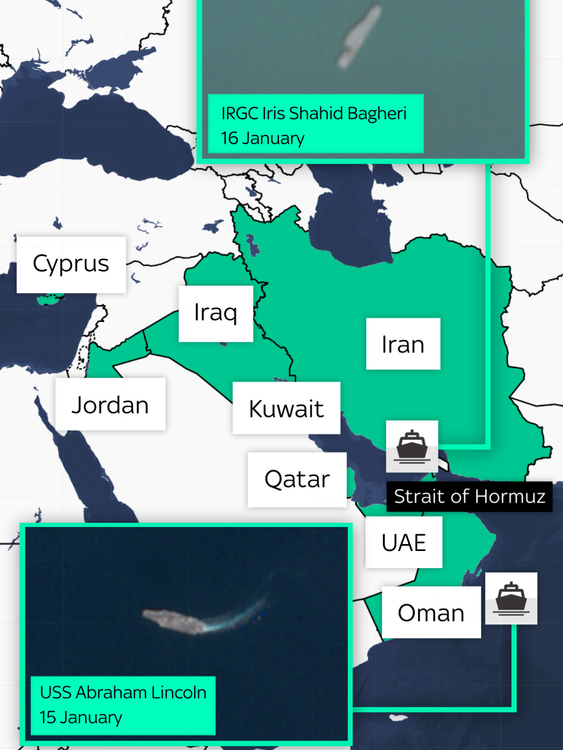
Sky News has tracked positions of Iranian Navy vessels using data by TankerTrackers
Sky News has tracked the positions of Iranian Navy vessels using data from TankerTrackers. Around six vessels can be seen just off the coast of Bandar Abbas on 16 January. One of these ships is an Iranian Drone Carrier, IRIS Shahid Bagheri. Satellite imagery confirmed its location on 16 January, 10km from the coast.
It is often spotted around this location in the Strait of Hormuz. It can deploy roughly 60 drones along with helicopters.